
Home > Get Ready Challenge > Stage One > Bushfire Basics

Knowledge is power. So before we get stuck into the Challenge, here’s a quick run-through of how bushfire behaves in the Blue Mountains.
In this article we’ll cover
- Why the Blue Mountains are such a high risk area
- The three ways fire can attack your home
- Why ember attack is your biggest threat (and also your biggest opportunity to prepare)
- The biggest risk to life during bush fire
Let’s get the basics sorted, then we’ll get you into the first task.
Do you know your risk in the Blue Mountains?
The Blue Mountains are widely considered one of the most bushfire-prone places in the world.
Most of us live along the tops of steep and heavily forested mountain ridges. The natural terrain, weather patterns and a dense covering of native vegetation that loves to catch fire all combine to make fire behaviour complex and potentially dangerous.
Three facts you should know about fire in our area:
- Fire runs uphill faster. For every 10 degrees of slope, fire can double its forward speed.
- In steep gullies, wind and slope combine to push flames towards homes on the ridge above and throw burning embers across our villages.
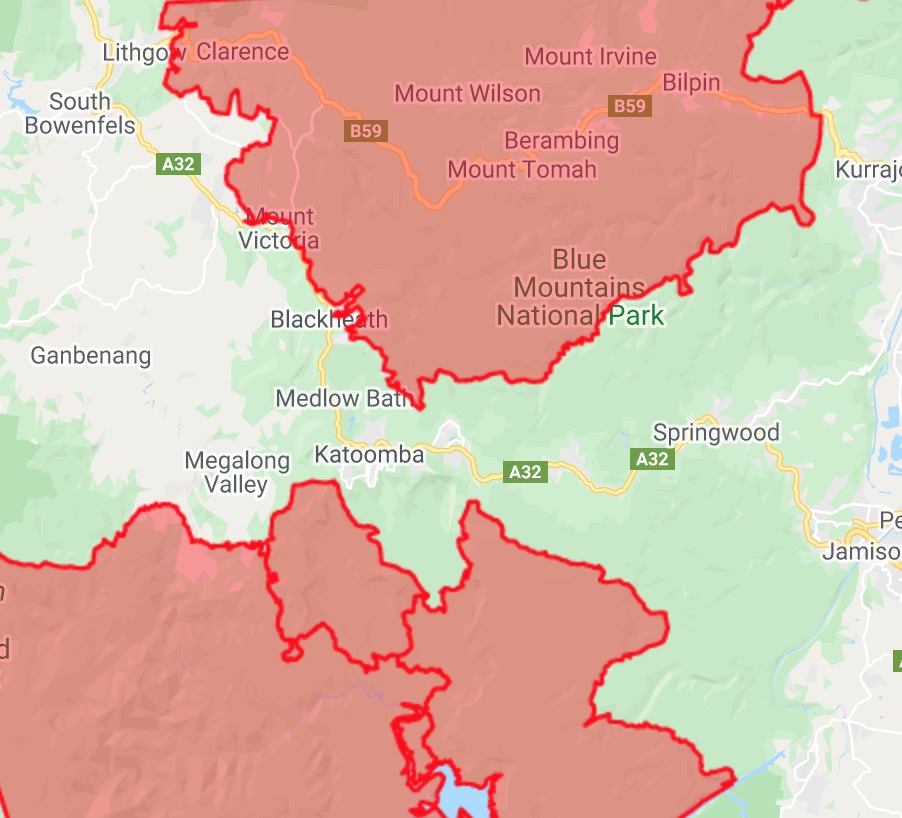
- The 2019-20 fires affected over 60 percent of the Blue Mountains, but left a wide green unburned corridor either side of the Great Western Highway. Since 2020 the bush has enjoyed five years of high rainfall. This has resulted in above-average growth in the understory, meaning more fuel for a bush fire.
The short story is, if you’re living in the Blue Mountains, you need to take the threat of bushfire seriously!
Fire’s three chief weapons
Fire has three main ways of damaging property.
- Flame – Direct contact when fire reaches your walls, roof, fences or nearby vegetation and travels from structure to structure
- Radiant heat – Even without flames touching the house, intense heat can crack windows, ignite materials at a distance, or dry out surfaces so they catch fire more easily.
- Ember attack – Flying sparks can travel kilometres ahead of the fire front, sneaking into gutters, decks and hidden corners and starting spot fires well before the main fire arrives.
Without serious firefighting equipment there’s only so much you can do about direct flame and radiant heat from a fire front. The place you can make a difference is against ember attack.
Ember attack
Did you know that 90% of homes lost in bush fires are due to ember attack?
During a bush fire, burning parts of trees such as twigs, branches or leaves become airborne and can be carried downwind of the bushfire.
One ember landing in a gutter, under a deck, or in a pile of leaves is all it takes to start a fire that quickly becomes uncontrollable.
An ’ember attack’ occurs when many embers are carried in a cluster by winds.
This 3-minute video illustrates an ember attack – something that many Blue Mountains residents have faced as recently as 2020.
How do embers form?
During a fire, burning material – bark, twigs, leaves – is lifted into the air and carried by wind.
In the Blue Mountains, stringybark eucalypts are notorious ember producers. They shed large, burning strips of bark that can travel kilometres.
That’s why fires can appear to “jump” ahead of themselves: embers land ahead of the fire front and start new spot fires. These can begin anywhere, from bushland to your back yard. And because embers can travel long distances, no home in the Blue Mountains is immune.
The Fire Triangle
Fire requires three things to keep burning: fuel, oxygen, and heat. Remove or reduce one and the fire will struggle.
You can’t control the weather, but you can do something about fuel – and this is where preparation really counts. By focusing on reducing fuel and limiting how fire can reach your home, you lower the risk of ignition.
Building/design standards use Bushfire Attack Levels (BAL) to estimate a property’s exposure to ember, radiant heat and flame, based on vegetation, slope and distance. For a good overview of the BAL system check out this link.
The biggest risk to life
Experience has shown that the greatest risk to life in a bush fire is to those involved in car accidents as a result of poor visibility and poor choices. Thick smoke and heat exposure while a fire front passes through can turn a moment of panic in to a deadly situation.
The safest move is a planned one. You can reduce your risk by planning ahead so you can make the right choices. Know when you’ll leave. Know how you’ll get out. And don’t wait until the last minute.
We’ll be returning to this topic in the first set of Challenge tasks.
That’s the theory – now let’s get practical!
You’ve got the basics. You know how fire behaves, and where you can make a difference.
Now it’s time to put that knowledge to work. The first task in the Challenge is to Rediscover Your Area – get outside, take a walk, and start seeing your neighbourhood the way a firefighter does.