

Home > Get Ready Challenge > Stage One > Exit Strategy

Where will you go if you need to evacuate?
So far in the Challenge we’ve covered basics of where you are and where fire could come from. Now it’s time to think about where you could go if you need to get out. Your bushfire safety plan starts here!
In this final task of Stage One you’re going to learn:
- What makes a good evacuation destination
- How to plan a safe and panic-free escape route
- how Neighbourhood Safer Places and Evacuation Centres work (and why you shouldn’t plan to use them)
- how to access info about past fire behaviour in your area.
Plan safe, leave early
You may already know that the greatest risk to life in a bush fire is to those involved in car accidents. Getting trapped in thick smoke and intense heat while a fire front passes through can turn your moment of panic into a deadly situation.
The safest advice is always to leave as early as possible. Which brings us to the question of…
What makes a good place to go?
When planning your ideal evacuation destination you need to be thinking of places that are:
- in a less bushfire prone area than your home
- easily accessible via road or public transport
- a place you can stay overnight or for a few days if necessary
- comfortable and suitable for all members of your household including pets.
Challenge Task: Plot your exit strategy
Complete this task now to save yourself precious time during a fire and reduce the likelihood of panic.
Write down the following questions and answers. You can use your neighbourhood survey from Task One – Rediscover Your Area as a cheat sheet.
- Identify one or more places you could stay overnight or for a few days
- What is the most direct route to the highway or main exit from your town or village?
- Find at least one alternative route in case fire or traffic block your planned route
- Locate a Neighbourhood Safer Place near your home. How far away is it? Could you walk there? Find a place near you
- Locate a place in your street that could make a safe temporary shelter if all else fails.
Evacuation Centres and Neighbourhood Safer Places
In a critical situation you may need to rely on an evacuation centre or a Neighbourhood Safer Place.
Both offer a place to go if your property comes under threat and should be factored into your Plan B. Neither is as good as having a safe and comfortable evacuation destination as part of your Bushfire Safety Plan.
Where is my nearest evacuation centre?
During a bushfire emergency an Evacuation Centre may be established in a town near you. The location will be chosen at the time based on need and safety. Information about this will be published on RFS social media and broadcast on ABC Radio 702 AM.
Evacuation centres are designed to meet the immediate needs of people who have left their properties in an emergency. You can read up here for more info on what to expect at an evacuation centre.
If you find yourself relying on an Evacuation Centre then your situation has either become serious very quickly, or your advance planning left something to be desired.
How do Neighbourhood Safer Places work?
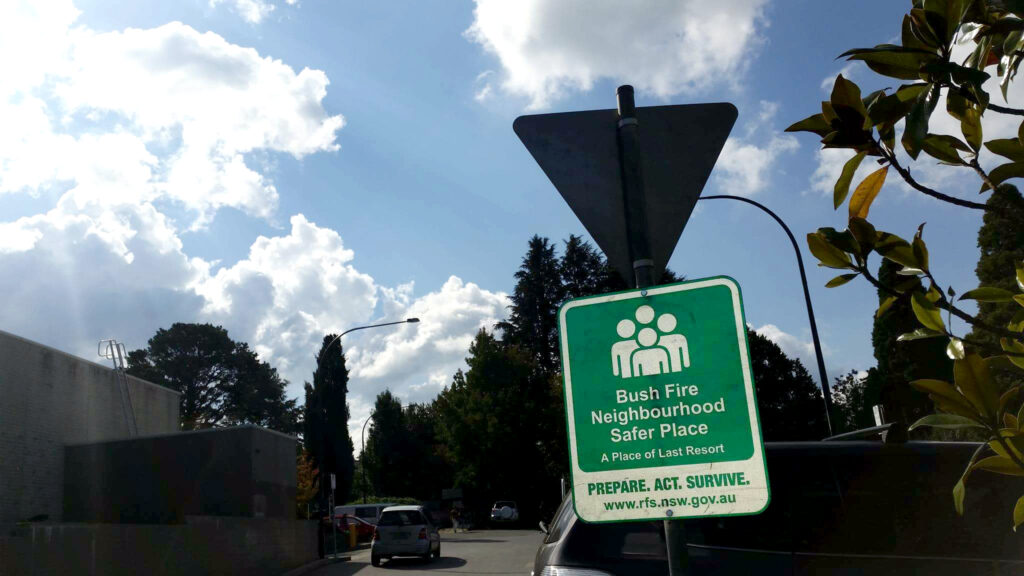
Most Blue Mountains villages have a designated Neighbourhood Safer Place, also known as a Place of Last Resort.
A “Safer Place” is simply an area that is less at risk of going up in flames during a fire front. It may be a car park, sports oval or other open paved area. Unlike an Evacuation Centre, there may be no shelter, toilets, food, water or other services.
They can get very busy and stressful in an emergency, so may not be an appropriate place for pets. However if your house is likely to come under bushfire attack and you are not prepared to stay and defend, a Neighbourhood Safer Place needs to be part of your backup plan.
Add your closest one to your neighbourhood mud map from Task One.
Useful websites during a fire
Save these sites to your bookmarks or favourites. If you can, get the apps for your phone or tablet too.
http://www.rfs.nsw.gov.au/fire-information/fires-near-me
https://www.livetraffic.com
https://transportnsw.info/
https://transportnsw.info/alerts/
http://www.ses.nsw.gov.au
Get to know your local bushfire history
A really useful tool for planning your exit strategy is to know how fire has moved through your area in the past.
And where’s the best place to get this info? Look no further than your friendly local RFS brigade! Check local media/social media for open days or a Get Ready Weekend event near you. These are usually held in September each year and are a fantastic opportunity to engage with your local volunteers and fire experts.
When you meet the crew look for the oldest and grubbiest uniform you can find – you’ll be sure to get some valuable local knowledge and interesting stories! (And possibly a few bad jokes).
This website has the contact details of every brigade in NSW.
Nice work!
If you’re participating the in Six Week Inbox Challenge, you’ve just completed Week One! Not too painful, was it? That’s a good solid start to your bushfire preparations. Keep an eye on your inbox next Friday for Week Two!
Let us know how you’re going! We always love to hear your tall tales and truth bombs. If you have any comments or questions feel free to send us a message any time on Facebook or our contact form.