Home > Get Ready Challenge > Stage Two > Make Your Plans to Leave

Making Plans To Leave
Now’s the time to tackle the toughest question of the whole Challenge: stay and look after your precious nest, or head for safety and hope for the best?
For most of us the safest answer is to leave early, and we’ve already looked at how to choose a good evacuation destination. But how will you know when it’s time?
In this article we’ll talk about
- How safety advice changed after Australia’s deadliest bushfires
- Setting your three triggers to leave
- Why you need to have plans in place for both leaving and staying
- What to factor in when deciding your leave time
No matter what you decide to do, the info and exercises in this article are the most important in the whole Challenge.
3 Scenarios: Leave, Stay or Shelter in Place
Scenario 1: Leave early
Make sure you go early and choose a place out of the risk area. Flick back to the Exit Strategy task in Stage One of the Challenge and make sure you know your options. Don’t forget to pack your spare undies and toothbrush! We’ll cover the timing in this article.
Scenario 2: Decide to stay and defend
Coming up later in Stage 2 we will cover the implications of staying and defending your home during a fire. You will need to be in excellent physical shape and have all your preparations in place.
Scenario 3: You come under immediate threat from the fire front
In the third scenario it may become unsafe to leave without assistance from emergency services. You will most likely hear statements like “It’s too late to leave” or “Shelter in place”. These indicate that the fire front is fast moving and intense and may impact on your escape routes or property very soon. In this scenario you need to quickly find defendable, solid shelter and prepare yourself to defend. Review your notes from the Rediscover your area Activity for insights on places to aim for (and to avoid!)
It may not be possible to carry out your plan A. So be prepared for all the above possibilities.
Whatever decision you take, check in with your friends and family so they know if you are safe.
‘Get out, and get out early’
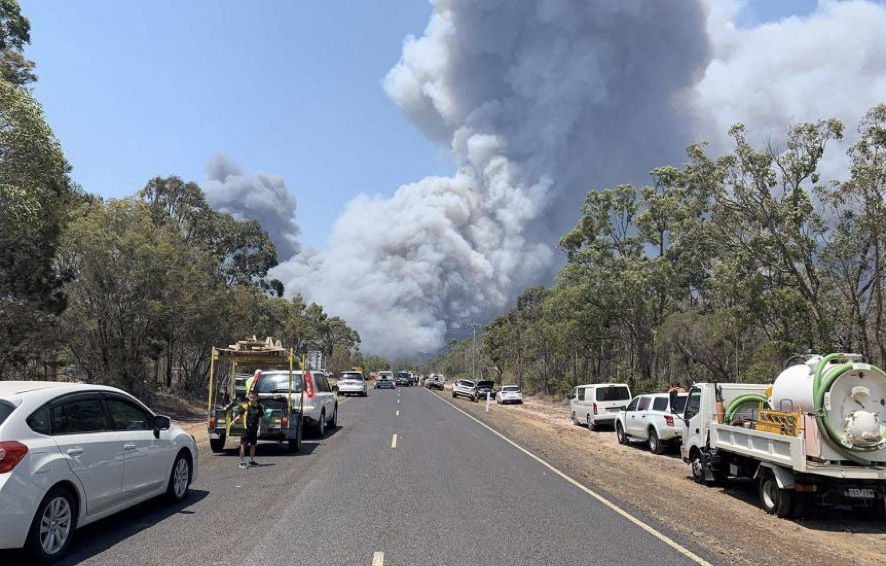
Cars and people lined up during a bushfire south of Bundaberg in southern Queensland.(ABC News: Sarah Jane Bell)
During the Black Saturday bushfires of 2009, most people died where they thought they would be safest.
Of the 173 people killed, two-thirds died in their own homes. Of those, a quarter died sheltering in the bath.
The subsequent Royal Commission into the Black Saturday fires applied much critical scrutiny to the existing ‘prepare, stay and defend or leave early’ policy, otherwise known as ‘stay or go’.
“The 2009 Black Saturday fires were a game changer,” said Dr Jim McLennan of LaTrobe University.
“Until then the general idea was, if you couldn’t leave well ahead of the fire, the safest thing was to stay and defend the house.”
He said the messaging has now changed.
“The emphasis is now on leave early.”
But while more people seem to be hearing that message and making the decision to leave early, they were failing to flesh out a detailed and safe escape plan.
“It’s one thing to decide we’re not going to stay. It’s quite another to say, ‘we’re going to go to x, and we will use either road z or road y, and our trigger to leave will be when we hear the fire is at a particular place’.
I want to leave early. But how early is that?
Good choice! Leaving early is always the safest option.
How early you need to go will depend on your location and situation. The priority is to avoid being trapped on the highway by an accident or fast moving fire front.
Pull out the map you used when you created your exit strategy and in the Location, Location, Location activity. Figure out how long it will take you to get where you want to go.
Give yourself extra time when planning to leave. Take in to account how long it will take to grab your emergency supplies, box of keepsakes, spare clothes and wrangle the kids, pets and anyone else who’s depending on you. (Stay tuned – we’ll help you speed up this whole process in Stage 3 of the Challenge.)
Morning is the best time to go
In most cases leaving early in the day gives you the most options. As the day heats up so does the fire activity. Understanding the forecast conditions may be part of your trigger to pack and go before there is a threat.
It may feel like you’re going too early. There will always be one more thing you could do.
But it’s much better to make this decision before the heat of the moment. A moment of indecision or panic paves the way for accidents happen and create a deadly situation. Leave it too late and you may not be able to get out at all.
Task: Know your Triggers To Leave
Now’s the time to put the finishing touches to those departure plans.
Grab your notebook and write down:
- 3 things that would make you want to leave your home
- 3 things that would make you feel safe to stay.
Examples of triggers to leave could be: “fire rating is Extreme or higher and I have dependents to care for”, or “a fire is within 5km and moving towards us”.
Examples of things that make you feel safe to stay could be “my household is fully prepared and ready to go at a moment’s notice” or “my neighbour’s house is built to latest building code and has a safe shelter”.
Stick this on your fridge and return to it as you learn more about fire and emergency preparedness. We will ask you how your notes changed after the Six Week Challenge concludes.
How will I know it’s time?
When there’s a fire you’ll need up-to-date information.
RFS official sources such as the Fires Near Me page are regularly updated with real time information on active fires.
Download the Hazards Near Me app (free from your device’s App Store). Set up a watch zone for your local area and any other areas that impact your plan (e.g. evacuation destination or a relative’s house). This will make it easier to know when there are new incidents that may impact you and your plan.
Other useful sources include
- Live Traffic website or app for road closure information
- Official social media feeds, such as your friendly neighbourhood bush fire brigade
- ABC Radio Sydney – (grab yourself a battery operated radio and tune to 702AM)
Look for updates and warnings: Warnings may be broadcast on TV and radio, posted on social media or through mobile phone networks. Please take heed of advice to prepare to evacuate. Always monitor the conditions around you by taking a look outside and compare it to what you are hearing or reading from agencies like the RFS, SES, Media outlets and Social Media sources. Be calm and objective, always confirm information by checking more than one source.
Local Facebook groups can be a wonderful source of rumour and unhelpful speculation, especially when there are helicopters in the air. Comments and images, even from well-meaning neighbours, may not represent the whole picture. Rather than jumping into panic mode, keep cool: compare what you can see, hear and smell with official information sources before jumping in on the discussion.
Next steps:
No matter what your plan it’s critical to have all the possibilities covered. So in the next two steps of the Challenge we’ll talk about what’s involved in staying and defending your property.